


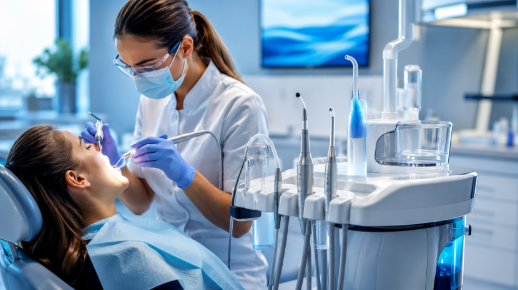
Professional dental cleaning has changed dramatically over the past decade. Where hygienists once relied on a standalone scaler and a separate polishing handpiece, today’s practices increasingly work with multifunction prophylaxis systems — single platforms that combine ultrasonic scaling, air polishing, periodontal treatment and implant maintenance in one device.
Among the manufacturers driving this shift, Woodpecker has become one of the most talked-about names, thanks to its PT series of prophylaxis units. In this article, we look at what these systems actually do, why they matter for both clinicians and patients, and how to decide which model fits your practice.
What is a prophylaxis system?
A prophylaxis system is an all-in-one hygiene station built around two core technologies:
- Ultrasonic scaling — high-frequency vibrations remove calculus (tartar) above and below the gumline, faster and more comfortably than hand instruments alone.
- Air polishing — a controlled jet of air, water and fine powder (typically glycine, erythritol or sodium bicarbonate) removes biofilm and stains gently, even on sensitive root surfaces and around implants.
Modern units like the Woodpecker PT series add periodontal therapy modes, implant maintenance protocols and even endodontic support, turning a single cart into a complete hygiene workflow.
Why clinics are switching to all-in-one units
1. Faster, more comfortable appointments
Switching between separate devices costs time and interrupts the workflow. An integrated system lets the clinician move from scaling to air polishing in seconds. For patients, features like heated water make a real difference: cold irrigation on exposed dentin is one of the most common causes of discomfort during a cleaning.
2. Better biofilm management
The profession has been moving toward biofilm-first protocols, where soft deposits are removed with low-abrasive powders before any mechanical scaling. Air-polishing technology with fine nozzles and controlled powder flow is central to this approach — and it’s exactly where the newest units have made the biggest engineering progress.
3. Implant maintenance
With millions of implants placed every year, safe peri-implant hygiene has become a daily requirement. Prophylaxis systems offer dedicated implant modes and powders that clean around titanium surfaces without scratching them.
Woodpecker PT-A and PT-B: two generations of the same idea
Woodpecker currently offers two multifunction prophylaxis platforms. The PT-A established the concept: a waterproof touchscreen unit combining air polishing, ultrasonic scaling, periodontal treatment and implant maintenance, with heated water at a fixed comfort temperature of 37°C and an anti-clogging powder system.
The PT-B is the newer generation, built on the same foundation but with significant upgrades: an Ultra HD touch display, a wireless Bluetooth foot pedal, a 300 W heating system with four selectable water temperatures (25°C to 40°C), twelve ultrasonic power levels, and refined nozzle engineering that concentrates the powder jet and reduces aerosol dispersion — a detail every hygienist who has cleaned powder off an operatory will appreciate.
So which one is right for your practice? The answer depends on your workflow, patient base and budget. For a detailed feature-by-feature breakdown — display, pedal, heating, nozzle design, power adjustment and a full comparison table — see this in-depth Woodpecker PT-A vs PT-B comparison, which concludes clearly which unit is newer and which offers the better performance for intensive professional use.
In short: the PT-A remains a solid, cost-effective all-in-one solution, while the PT-B is the more advanced, future-proof platform for practices that want maximum control and automation.
What this means for patients
If you’re a patient rather than a practitioner, here’s the takeaway: these systems are one of the reasons professional cleanings have become noticeably gentler in recent years. Warm water instead of cold, fine powders instead of gritty pastes, and adjustable power instead of one-size-fits-all scaling all translate into shorter, more comfortable appointments — and better long-term gum health.
If dental cleanings have felt uncomfortable for you in the past, it’s worth asking your dental practice whether they use air polishing and heated-water technology. The difference is real.
Maintenance matters, too
Like any precision dental equipment, prophylaxis units perform at their best only when properly maintained: regular purging of powder chambers, cleaning of nozzles and handpieces, and timely replacement of worn components such as scaler tips and O-rings. The PT-B even automates part of this with a self-cleaning function after periods of inactivity. A well-maintained unit protects your investment and — more importantly — guarantees consistent, hygienic performance for every patient.
Conclusion
Multifunction prophylaxis systems represent a genuine step forward in preventive dentistry: faster workflows for clinicians, gentler treatments for patients, and better outcomes for both. Woodpecker’s PT series shows how quickly this category is evolving — and with the PT-B, how much room there still is for smart engineering in something as routine as a dental cleaning.
Whether you’re equipping a new hygiene room or upgrading an aging scaler-plus-polisher setup, an all-in-one prophylaxis unit deserves a serious look.