


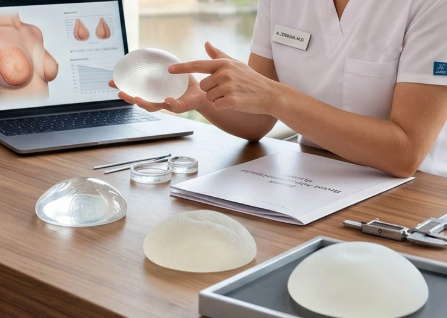
Ever thought about how it could possibly be that two girls who have the same volume of implants look totally different from one another? While one girl gets her “teardrop” with a softer shape, the other girl will get her chest to become fuller, even resembling that famous “Instagram look.” Selecting a brand in Europe is not only about status and money; it’s also the math of tissues and geometries, as well as the tastes of the surgeon you will trust your body with.
Geometry vs marketing
As soon as you begin your journey to study forums or clinic websites, several names pop into view instantly – Motiva, Mentor, Polytech. Apparently, you receive automatic protection from any possible troubles when choosing the most expensive option. However, everything is not so simple.
Dr. Zykov, a plastic surgeon with extensive practice in breast augmentation, puts it plainly: „An experienced surgeon can achieve beautiful results with virtually any reputable brand — Motiva, Polytech, Mentor, Eurosilicone, Nagor — provided the geometry is right. Even implants with identical width, height, and projection measurements can carry significantly different actual volumes depending on the manufacturer. What matters most, he emphasizes, is minimizing complications while preserving long-term results — and that means the shell coating deserves just as much attention as the number on the box.“
Indeed, the goal here is not only to make the product bigger but also to ensure zero complications and pleasant aesthetics. However, if you base your opinion on evidence-based medicine, it is clear today that two coatings are recognized by statistics as the most acceptable for the body. They are nanotextured shells of Motiva and micropolyurethane foams of Polytech.
Why Motiva is a hot topic in Europe
Currently, the brand of Motiva implants is the most widely discussed product in Europe. Its distinctive feature is a nanotextured shell. To the touch, it seems to be smooth, but at the microscopic level, a special surface appears. In practice, the reaction of the body to such a coating turns out to be extremely small. The body, as if, does not show aggression towards an alien object. After all, any foreign object will be rejected by the body; it’s physiologically natural. With nanotexture, however, the most delicate capsule is formed.
The implants from the Ergonomix 2 line deserve particular attention. This is a completely different story regarding the behavior of the material in the body. The shape adapts to the position in which you find yourself – when standing, a natural teardrop is formed, while lying down, the breasts expand laterally. No „glued balls,“ only naturalness and naturalness.
The German quality of Polytech and classic Mentor
Whereas Motiva is focused on innovations, Polytech is more German stability. The company manufactures implants with a polyurethane layer. On a basic level, these are standard silicone implants; however, there is an additional layer on them, like a thin sponge. On the one hand, by touch, the layer resembles microtextured implants. However, this is not the case, as the layer literally „sticks“ to the tissues, ensuring the minimum risk of displacement. This feature becomes a key factor in favor of active women for whom sports are a daily activity.
Moreover, I would like to add another interesting note. Sometimes, the light in operating rooms falls in such a way that the texture of the implant becomes like real jewelry work. Thus, I would like to say that technologies in this area have developed a lot.
However, Mentor is the „gold standard.“ American classics, which proved their value through decades of use. European surgeons love these implants because of their predictable behavior. In case Mentor is taken, the doctor clearly understands what kind of implant will be operated by him after five or ten years. It has a very dense, cohesive gel, which retains its shape perfectly without moving, even under special conditions.
Price of surgery in Europe
The prices of surgery in Europe can be called an enormous construction kit. While in Poland or Czech Republic one might pay from 3500 till 5000 EUR, then in Germany, Switzerland, or France the price will definitely range between 7000–9000 euros. However, this is not only about implant costs themselves. The total price also covers such elements as insurance, anesthetist’s fees, and a stay in a special room.
However, implants in terms of acquisition cost almost the same money from different clinics within the European Union – the main difference lies in the markup on the clinic itself and the services provided. In this case, it should be said that Motiva implants always tend to be somewhat more expensive owing to patents and chips. Polytech and Mentor fall into the same price category, however, the polyurethane implants of the Germans can prove more expensive than regular ones.
Thus, in essence, you do not choose a brand, but how you see yourself looking at your reflection in the morning. In this connection, comes a truly intriguing point – are you ready to rely on dry statistics only, or are you still going to seek „the very“ doctor who perceives beauty the way you perceive it?